CODE LAB
평가 지표·연습 문제
F-beta Score + Optimal Threshold [medium]
LEVEL 2PRACTICE
문제 설명PROBLEM
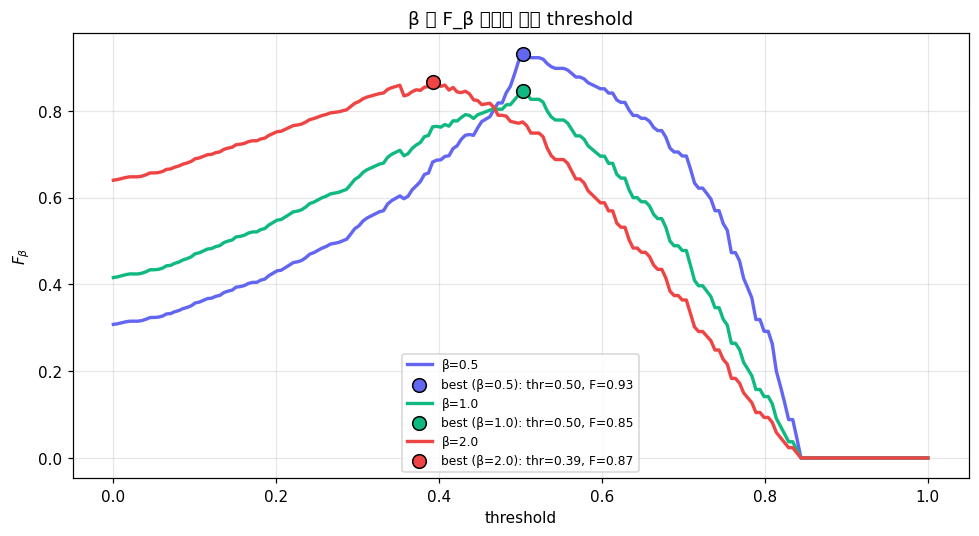
F-beta + Optimal Threshold [medium]
v1 F1 은 (P 와 R 을 동등 가중). 실무에서는 태스크에 따라:
- 스팸: FP 가 비싸 → precision 중시 → (예: )
- 암 진단: FN 이 치명적 → recall 중시 → (예: )
일반화:
그리고 실제 분류기는 continuous score 를 냄. 고정 threshold 는 불균형 데이터에서 최적이 아닐 수 있음 → 점수 자체를 threshold 로 스윕해 가 최대가 되는 지점 찾기.
스윕 전략
np.sort(np.unique(y_score))→ 후보 thresholds.- 각 threshold 에서
y_pred = (y_score >= threshold)→ TP/FP/FN 계산. - 계산. (분모 0 → 0.0.)
- argmax 로 최적 threshold 와 반환.
효율적 구현은 argsort(-y_score) 한 번에 cumulative TP/FP 로 .
과제
함수 fbeta_best_threshold(y_score, y_true, beta) 를 완성하세요.
y_score: 양성 점수, shape(N,).y_true: 0/1 정수 레이블.beta: 양수.- 반환:
(best_threshold, best_fbeta)— 둘 다 Pythonfloat. - 모든 양성을 예측했을 때 (threshold = 최소 score 이하) 도 평가.
- 동점 threshold 는 작은 threshold 를 선택 (= recall 을 포기하지 않음).
테스트 케이스
| # | 이름 | 검증 |
|---|---|---|
| 1 | 반환 2-tuple (thr, f) | |
| 2 | 완벽 분리 → fbeta=1.0 (어떤 β 든) | |
| 3 | β=1 → F1 정의와 일치 | |
| 4 | β=2 > 1 → recall 높은 threshold 선호 (작은 threshold) | |
| 5 | β=0.5 < 1 → precision 높은 threshold 선호 (큰 threshold) | |
| 6 | threshold 는 scores 중 하나 또는 min(score)-ε | |
| 7 | sklearn fbeta_score 와 일치 (최적 threshold 에서) |
개념 노트와 실수 포인트
평가 지표
- ⚠️ 정확도는 클래스 불균형에 약함(99% 음성이면 다 음성 찍어도 99%).
- 정밀도(예측한 양성 중 진짜) vs 재현율(실제 양성 중 잡은 것) 트레이드오프, F1=조화평균.
코드 작성PYTHON 3
Loading...
SUBLIMETab들여쓰기Ctrl/⌘ + /주석Ctrl/⌘ + Shift + D줄 복제
실행 결과
실행 대기코드를 작성하고 실행하면 5개의 테스트가 각각 표시됩니다.