CODE LAB
거리/유사도·연습 문제
K-Nearest Neighbors Search [medium]
LEVEL 2PRACTICE
문제 설명PROBLEM
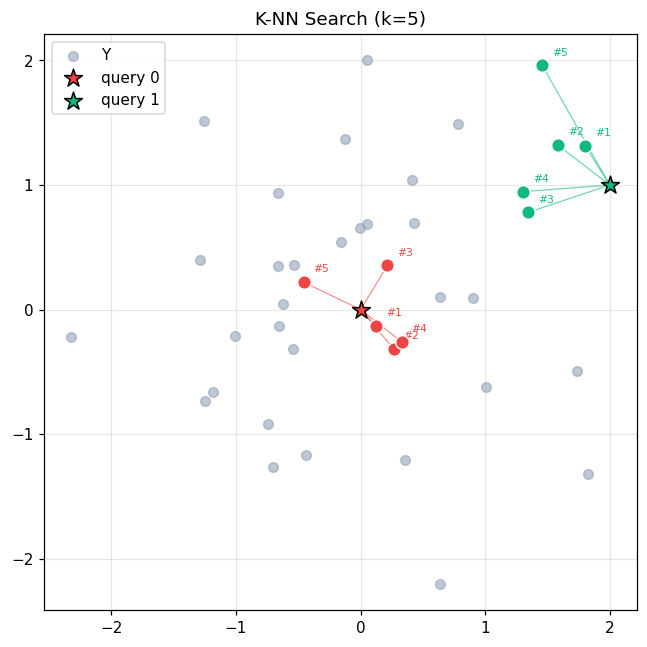
K-Nearest Neighbors Search [medium]
v1 pairwise distances 로 (N, M) 거리 행렬을 얻었다면, 보통 다음 단계는 각 query 에 대해 k 최근접 을 뽑는 것. 전체 argsort 는 per row; argpartition 은 per row — 정확도는 같지만 더 빠름.
알고리즘
D = pairwise Euclidean distancesshape(N, M).- 각 row 에서 가장 작은 k개의 인덱스 추출:
idx_unsorted = np.argpartition(D, k, axis=1)[:, :k]. - 이 인덱스를 거리 순으로 정렬 하고 싶으면, 해당 거리를 가져와 argsort 로 재정렬.
과제
함수 knn_search(X, Y, k) 를 완성하세요.
Xshape(N, d)query,Yshape(M, d)database,k정수.- 반환:
(idx, dists)튜플.idxshape(N, k): 각 row 는 query i 의 k 개 nearest Y 인덱스 (거리 오름차순).distsshape(N, k): 해당 거리 (오름차순).
- 루프 금지.
힌트
D = pairwise_euclidean(X, Y)                 # (N, M)
idx_unsorted = np.argpartition(D, k, axis=1)[:, :k]
dist_unsorted = np.take_along_axis(D, idx_unsorted, axis=1)
order = np.argsort(dist_unsorted, axis=1)    # 거리 기준 재정렬
idx = np.take_along_axis(idx_unsorted, order, axis=1)
dists = np.take_along_axis(dist_unsorted, order, axis=1)
return idx, dists
테스트 케이스
| # | 이름 | 검증 |
|---|---|---|
| 1 | shape (N, k) × 2 | |
| 2 | 거리 오름차순 | |
| 3 | k=1 → 최근접 1개 | |
| 4 | X ⊂ Y 일 때 자기 자신이 1등 (거리 0) | |
| 5 | idx ∈ [0, M) | |
| 6 | 손계산 toy |
개념 노트와 실수 포인트
거리·유사도
- 유클리드(L2)/맨해튼(L1)/코사인.
- ⚠️ 코사인 유사도는 크기를 무시하고 방향만 봄 — 정규화 효과.
코드 작성PYTHON 3
Loading...
SUBLIMETab들여쓰기Ctrl/⌘ + /주석Ctrl/⌘ + Shift + D줄 복제
실행 결과
실행 대기코드를 작성하고 실행하면 5개의 테스트가 각각 표시됩니다.