CODE LAB
데이터 분할·연습 문제
Stratified Train-Test Split [medium]
LEVEL 2PRACTICE
문제 설명PROBLEM
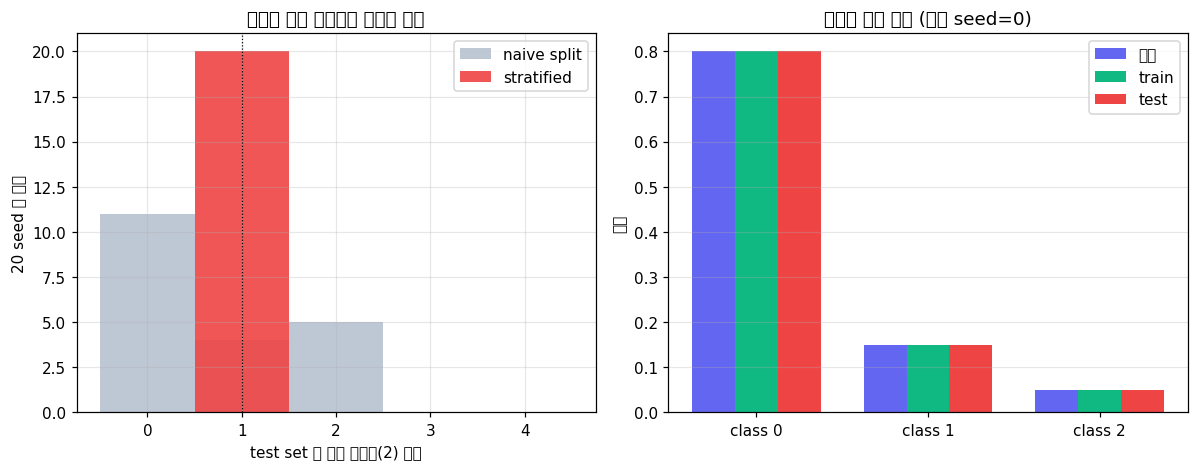
Stratified Train-Test Split [medium]
v1 분할 은 전체를 섞어 자르기만 함 → 클래스 불균형 (imbalanced) 데이터면 test 에 아예 양성이 없는 사고 발생 가능.
Stratified split: 각 클래스 내부에서 따로 섞어 분할 → train 과 test 의 클래스 비율이 원본과 동일 하게 유지.
알고리즘
for c in 고유 클래스들:
    해당 클래스 인덱스를 섞는다
    n_test_c = round(len(class_c) * test_ratio)   # 각 클래스에서 비율만큼
    test_idx 에 class_c[:n_test_c] 추가
    train_idx 에 class_c[n_test_c:] 추가
train/test 각각 다시 한 번 섞어 순서 무작위화 (optional, 재현성)
왜 중요한가
- 희귀 클래스: 양성 5% 데이터에서 일반 split 을 하면 test 에 양성이 0개 나올 확률이 실제로 있음.
- 교차 검증: 모든 fold 의 클래스 분포가 같아야 평가가 안정.
sklearn.model_selection.train_test_split(stratify=y)가 바로 이것.
과제
함수 stratified_split(X, y, test_ratio, seed) 를 완성하세요.
Xshape(N, D),yshape(N,)정수 레이블.- 반환:
(X_train, X_test, y_train, y_test). - 각 클래스에서
round(count_c * test_ratio)개를 test 로. rng = np.random.default_rng(seed)한 번만 만들고 전체 과정에 사용.- 힌트:
np.unique(y)로 클래스 모으고, 클래스별rng.permutation후 슬라이스.
테스트 케이스
| # | 이름 | 검증 |
|---|---|---|
| 1 | 반환 4-tuple | |
| 2 | 클래스 비율 보존 (train, test 둘 다) | |
| 3 | 시드 재현성 | |
| 4 | train + test 합 = 원본 (셔플 보존) | |
| 5 | 희귀 클래스도 test 에 포함 | 5% 클래스 → 0 아닌 개수 |
| 6 | test 개수 ≈ N·test_ratio (±1·클래스 수) | |
| 7 | X 와 y 인덱스 일관성 |
개념 노트와 실수 포인트
데이터 분할
- train(학습)/val(튜닝)/test(최종 평가).
- ⚠️ test 는 마지막에 한 번만 — 누수 금지.
코드 작성PYTHON 3
Loading...
SUBLIMETab들여쓰기Ctrl/⌘ + /주석Ctrl/⌘ + Shift + D줄 복제
실행 결과
실행 대기코드를 작성하고 실행하면 5개의 테스트가 각각 표시됩니다.